

Uttar Pradesh
Home of the Taj Mahal & the Sacred Ganges
Uttar Pradesh, India's most populous state, is home to the iconic Taj Mahal, the sacred city of Varanasi, and centuries of Mughal and Awadhi heritage along the Ganges plains.
About Uttar Pradesh
Overview
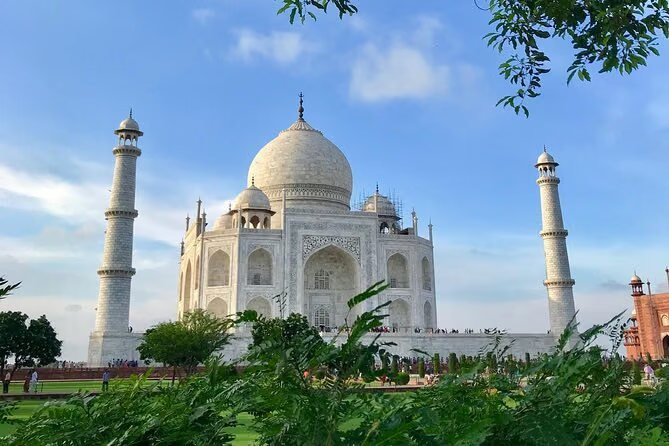
Uttar Pradesh is India's most populous state and one of its most historically significant, stretching across the fertile Indo-Gangetic plains in the north. Its capital, Lucknow, is renowned for Awadhi cuisine, courtly etiquette, and Nawabi architecture, while Agra draws travelers worldwide to the Taj Mahal, Agra Fort, and nearby Fatehpur Sikri. Varanasi, one of the world's oldest continuously inhabited cities, sits on the banks of the Ganges and remains one of Hinduism's holiest pilgrimage sites, alongside Prayagraj, host of the Kumbh Mela. Mathura and Vrindavan, associated with the birth of Lord Krishna, add further spiritual depth to the state. Hindi is the predominant language, with Urdu also widely spoken, reflecting Uttar Pradesh's layered Hindu-Muslim cultural history. With three UNESCO World Heritage Sites and a legacy spanning ancient kingdoms, Mughal emperors, and the freedom movement, Uttar Pradesh remains central to India's history and identity.
- Taj Mahal (UNESCO, 1983) — Agra
- Agra Fort (UNESCO, 1983)
- Fatehpur Sikri (UNESCO, 1986)
- Kumbh Mela at Prayagraj — world's largest religious gathering
Top Destinations in Uttar Pradesh
View All DestinationsTour Packages for Uttar Pradesh




Culture & Heritage
Uttar Pradesh's culture reflects centuries of layered history, from ancient Vedic and Buddhist roots to the refined Nawabi courts of Awadh and the grandeur of Mughal architecture. Its cities remain living centers of classical music, dance, craft, and religious tradition.
- Mughal & Nawabi Architecture
- Kathak Classical Dance
- Banarasi Silk Weaving
- Ganga Aarti & Riverside Rituals
Famous Festivals
- Kumbh Mela — Cyclical, largest every 12 yearsThe world's largest religious gathering, held at Prayagraj on the banks of the Ganges.
- Dev Deepawali — NovemberVaranasi's ghats are lit with thousands of oil lamps to celebrate the festival of the gods.
- Holi — MarchCelebrated with particular fervor in Mathura and Vrindavan, the birthplace of Lord Krishna.
Food of Uttar Pradesh
- Awadhi BiryaniA fragrant, slow-cooked rice dish from the royal kitchens of Lucknow.
- Tunday Kebabi KebabsMelt-in-the-mouth minced meat kebabs, a Lucknow specialty with a legendary spice blend.
- ChaatTangy, spicy street snacks that originated in the alleys of Uttar Pradesh's cities.
- PethaA translucent candied ash-gourd sweet that is Agra's signature confection.
Travel Information
How to Reach
- Major airports at Lucknow, Varanasi, Agra, and Kushinagar connect the state domestically and internationally.
- One of India's densest rail networks links Lucknow, Agra, Varanasi, Kanpur, and Prayagraj.
- Extensive national highway network, including the Yamuna and Agra-Lucknow expressways.
Nearest Airports
- Chaudhary Charan Singh International Airport (LKO) — Lucknow
- Lal Bahadur Shastri Airport (VNS) — Varanasi
- Agra Airport (AGR) — Agra
Travel Tips
- Book Taj Mahal tickets online in advance and visit early morning to avoid crowds and heat.
- Summers (Apr–Jun) can exceed 45°C in the plains; winters (Dec–Jan) bring dense fog affecting travel.
- During the Kumbh Mela and other major festivals, accommodation in pilgrimage cities books out well ahead.
Frequently Asked Questions
October to March is by far the best window, with mild daytime temperatures that make walking around the Taj Mahal, Agra Fort, and Varanasi's ghats genuinely pleasant. Winter mornings (Dec-Jan) can bring dense fog that occasionally delays flights and trains, so it's worth building a little buffer into travel days during that stretch. Avoid April through June, when plains temperatures regularly cross 45°C and sightseeing outdoors becomes exhausting; the monsoon months (Jul-Sep) are cooler but bring humidity and occasional flooding along the Ganges. If your trip includes Dev Deepawali in November, plan well ahead, as Varanasi's hotels fill up quickly around that festival.
A full week lets you comfortably combine the state's major circuit: two days in Agra for the Taj Mahal, Agra Fort, and a side trip to Fatehpur Sikri, two to three days in Varanasi for the ghats, Kashi Vishwanath Temple, and a Ganga Aarti evening, and a day or two in Lucknow for its Nawabi architecture and Awadhi food. If time allows, add a day to visit Mathura and Vrindavan or Prayagraj. For a shorter trip of three to four days, focus on just Agra and Varanasi, which are well connected by rail and cover the state's two most iconic experiences without excessive travel time in between.
Uttar Pradesh is most famous for the Taj Mahal, one of the world's most recognisable monuments and part of a trio of UNESCO sites in Agra alongside Agra Fort and Fatehpur Sikri. It's equally renowned for Varanasi, one of the world's oldest continuously inhabited cities, where the Ganges ghats and evening Ganga Aarti draw pilgrims and travellers alike. The state also carries deep significance in Hindu mythology through Ayodhya, Mathura, and Vrindavan, and it hosts the Kumbh Mela at Prayagraj, the largest religious gathering on earth, alongside a refined Nawabi culinary and cultural legacy centred on Lucknow.
Lucknow's Chaudhary Charan Singh International Airport (LKO) and Varanasi's Lal Bahadur Shastri Airport (VNS) are the state's two main gateways, both with strong domestic and some international connectivity. Agra has its own smaller airport (AGR) with limited flights, so most visitors headed there fly into Delhi or Lucknow and continue by road or rail instead. Which airport makes most sense depends on your itinerary's starting point — VNS if you're beginning in Varanasi, LKO if Lucknow or the Awadh region comes first.
Yes, the Agra-Varanasi-Lucknow circuit is one of India's most established tourist routes, with well-developed hotel infrastructure, trained guides, and accessible transport options suited to organised group travel. That said, some walking is unavoidable — the Taj Mahal complex and Varanasi's narrow ghat lanes involve uneven surfaces and stairs, so comfortable footwear and a relaxed pace help. Wheelchairs and golf-cart-style transport are available at the Taj Mahal for those who need them, and boat rides on the Ganges offer a low-effort way for seniors to experience Varanasi's ghats without extensive walking.