
Sightseeing in Mahabalipuram
Mahabalipuram, also known as Mamallapuram, is a UNESCO World Heritage Site on Tamil Nadu's Coromandel coast, celebrated for its 7th-century Pallava rock-cut architecture and monoli
Overview
Mahabalipuram, also known as Mamallapuram, is a UNESCO World Heritage Site on Tamil Nadu's Coromandel coast, celebrated for its 7th-century Pallava rock-cut architecture and monolithic masterpieces. Highlights include the Shore Temple, one of South India's oldest structural stone temples, and the Pancha Rathas, five granite chariot-shaped monoliths. Visitors also marvel at Arjuna's Penance, a colossal open-air bas-relief, and Krishna's Butterball, a precariously balanced boulder, all set against a scenic seaside backdrop.
Places
Shore Temple
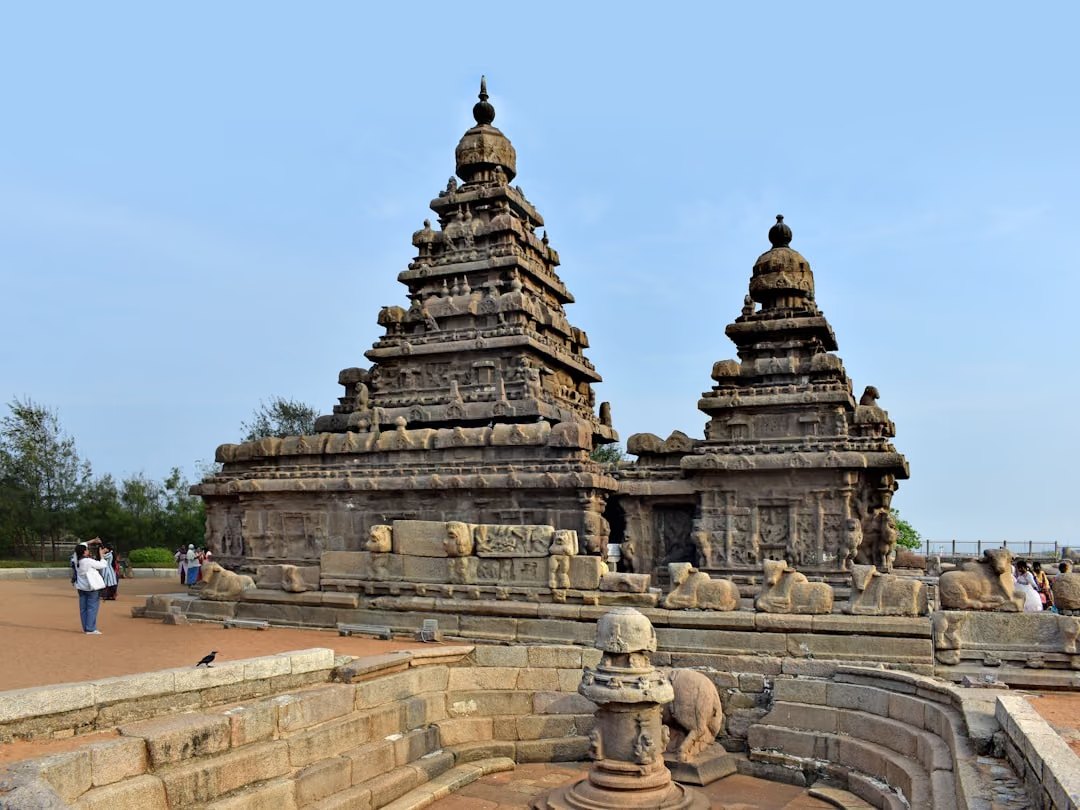
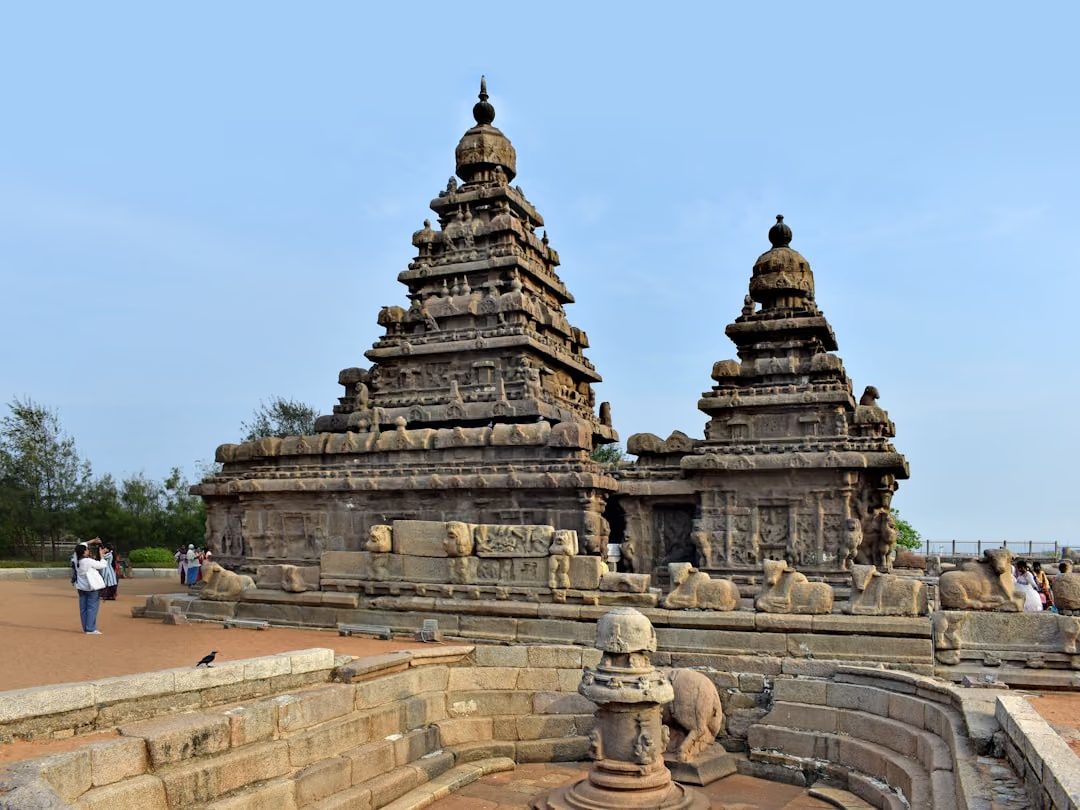
1 to 2 hoursThe Shore Temple, built during the reign of Narasimhavarman II (Rajasimha) of the Pallava dynasty in the 7th-8th century CE, stands as a masterpiece of Dravidian architecture on the Coromandel Coast. Carved entirely from local granite, this twin-shrine complex is dedicated primarily to Shiva, with a smaller shrine to Vishnu, reflecting the religious tolerance of the Pallavas. Its pyramidal vimanas and intricate sculptures have weathered relentless ocean winds and salt spray for over 1,200 years, making it a UNESCO World Heritage Site and a testament to the engineering prowess of ancient India. The temple's location, once a bustling port, now offers breathtaking views of the Bay of Bengal, with the rising sun illuminating its weathered stones each morning.
Pancha Rathas (Five Rathas)
1-2 hoursThe Pancha Rathas, also known as the Five Rathas or Pandava Rathas, are a remarkable cluster of five monolithic temples in Mahabalipuram, Tamil Nadu. Each ratha is hewn from a single, large granite boulder, a feat of Dravidian rock-cut architecture dating to the 7th century under the Pallava dynasty. The temples are named after the Pandava brothers—Dharmaraja, Bhima, Arjuna, Nakula Sahadeva—and Draupadi, though they are not actually associated with the epic. They showcase distinct architectural styles, including square, rectangular, and apsidal plans, and are adorned with intricate carvings of deities, animals, and mythological scenes. The site is part of the Group of Monuments at Mahabalipuram, a UNESCO World Heritage Site, and remains a testament to the artistic and engineering prowess of the Pallavas.
Arjuna's Penance
1 to 2 hoursArjuna's Penance, also known as the Descent of the Ganges, is a monumental open-air bas-relief carved on two adjacent granite boulders in Mahabalipuram. Dating to the Pallava dynasty (7th century CE, likely under Narasimhavarman I), this masterpiece stretches about 27 meters in length and 9 meters in height, making it one of the largest rock reliefs in the world. The central natural cleft represents the Ganges River descending from the heavens, flanked by over a hundred carved figures—ascetics, deities, animals, and mythological beings. The scene is often interpreted as depicting King Bhagiratha's penance to bring the Ganges to earth, though some scholars suggest it illustrates Arjuna's penance to obtain the Pashupatastra from Shiva. The relief showcases remarkable naturalism, with life-sized elephants, monkeys, and deer, and intricate details of daily and celestial life. It is a UNESCO World Heritage Site and a pinnacle of Indian rock-cut art.
Krishna's Butterball
30 minutes to 1 hour for the boulder and surrounding area.Krishna's Butterball is a colossal granite boulder, roughly 6 meters in diameter and weighing over 250 tons, resting on a 45-degree slope in the historic town of Mahabalipuram. Despite its seemingly impossible position, the boulder has never rolled down, captivating visitors and engineers alike. Local legend identifies it as a giant ball of butter that the child Krishna loved to steal, while some believe Pallava king Narasimhavarman I attempted to move it with elephants and failed. The site offers a unique photo opportunity and a chance to witness nature's extraordinary balance, with views of the surrounding rock formations and the distant shore temple.
Mahishasuramardini Cave Temple
45 minutes to 1 hourThe Mahishasuramardini Cave Temple, carved during the Pallava dynasty in the 7th century, is a celebrated rock-cut shrine in Mahabalipuram. Its fame rests on an exceptional bas-relief panel depicting Goddess Durga in her Mahishasuramardini form, triumphantly piercing the buffalo demon with her trident. The cave features three sanctum niches flanked by sculpted panels of Vishnu and Brahma, reflecting the Pallavas' artistic and religious synthesis. The dynamic composition, with Durga riding her lion and the demon in human form, is considered one of the finest examples of Pallava art. This cave temple offers a profound glimpse into ancient Indian mythology and sculptural mastery.
Mahabalipuram Lighthouse
Mahabalipuram has had lighthouses in some form for well over a thousand years: the old Olakkanatha temple structure, dating to the Pallava period, is thought to have doubled as a navigational marker for sailors long before a modern lighthouse was built nearby in the 20th century. Climbing the newer tower rewards visitors with panoramic views over the Five Rathas, the coastline, and the surrounding boulder-strewn landscape. Together the two structures illustrate the town's long relationship with the sea. Mahabalipuram Lighthouse sits at an elevation of 11 m and is typically explored in about 30-45 minutes. The most favourable months to visit are December, February, March, and April, when conditions are best suited for sightseeing. Nearby points of interest include Krishna's Butter Ball, Varaha Cave Temple, and Mahabalipuram Lighthouse. Other notable highlights include climb spiral stairs to see 360-degree sea view, spot Shore Temple from lighthouse’s top platform, and observe old Pallava stone lantern beside new tower. It falls within Chengalpattu district and Tamil Nadu, India.
Mahabalipuram Beach
1-2 HoursStretching along the Coromandel coast beside the historic town, this beach pairs a relaxed seaside atmosphere with the backdrop of one of India's oldest surviving stone temples. Fishing boats dot the shoreline in the early mornings, and the beach's proximity to the UNESCO monument complex makes it a natural pause point for visitors exploring the area. Its gentler pace and open horizon offer a contrast to the carved granite landscape just inland. Mahabalipuram Beach sits at an elevation of 0 m and is typically explored in about 1-2 hours. The most favourable months to visit are December, February, March, and April, when conditions are best suited for sightseeing. Nearby points of interest include Arjuna's Penance, Pancha Rathas, and Mahishasuramardini Cave. Other notable highlights include shore Temple silhouette at golden sunrise, ancient stone chariots along the seafront, and fishermen hauling catamarans at dawn. It falls within Mahabalipuram, Chengalpattu district, and Tamil Nadu.
Mahabalipuram Sculpture Museum
1 HourThis museum curates a collection of stone and bronze sculpture that traces South Indian sculptural traditions from ancient temple art to contemporary work, fitting for a town whose stone-carving lineage stretches back to the Pallava dynasty. Mahabalipuram remains home to active workshops where artisans still train in traditional techniques, many of them descendants of craftsmen who worked on the town's ancient monuments. The museum offers useful context for understanding the carvings scattered throughout the surrounding archaeological site. Mahabalipuram Sculpture Museum sits at an elevation of 11 m and is typically explored in about 1 hour. The most favourable months to visit are December, February, March, and April, when conditions are best suited for sightseeing. Nearby points of interest include Shore Temple, Mahishasuramardini Cave Temple, and Krishna's Butter Ball. Other notable highlights include view ancient Pallava-era stone carvings indoors, spot bronze Nataraja idols from Chola period, and compare modern workshop pieces with museum originals. It falls within Chengalpattu district and Tamil Nadu.
Tiger Cave
30-45 MinutesSet apart from Mahabalipuram's main cluster of monuments in a quieter, forested setting, this Pallava-era rock excavation features a small shrine framed by a semicircle of carved yali heads, mythical lion-like creatures whose fanged expressions gave the site its popular name. Historians believe the open space in front once served as a stage for royal or ceremonial functions. Its relative seclusion makes it a peaceful stop away from the busier heritage sites in town. Tiger Cave sits at an elevation of 12 m and is typically explored in about 30-45 minutes. The most favourable months to visit are December, February, March, and April, when conditions are best suited for sightseeing. Nearby points of interest include The Main Mandapa, Tiger Cave, and The Ganesha Shrine. Other notable highlights include rock-cut yali heads roaring from the shrine facade, climb the granite steps to the open-air mandapa, and cool, shaded interior away from the crowds. It falls within Chengalpattu district and Tamil Nadu, India.
Tour Packages for Mahabalipuram




Explore More of Mahabalipuram
Destination Hub
Mahabalipuram OverviewSpiritual & Temple Guides
Places to Explore
Discover attraction
Discover attraction
Discover attraction
Discover attraction
Discover attraction
Discover attraction
Discover attraction
Discover attraction
Discover attraction
Discover attraction
Discover attraction
Discover attraction
Discover attraction
Discover attraction
Discover attraction
Discover attraction
Discover attraction
Discover attraction
Discover attraction
Discover attraction
Discover attraction
Discover attraction
Discover attraction
Discover attraction
Discover attraction
Discover attraction
Discover attraction
Discover attraction
Discover attraction
Discover attraction
Discover attraction
Discover attraction
Discover attraction
Discover attraction
Discover attraction
Discover attraction
Discover attraction
Discover attraction
Discover attraction
Discover attraction
Discover attraction
Discover attraction
Discover attraction
Discover attraction
Discover attraction
Discover attraction
Discover attraction
Discover attraction
Discover attraction
Discover attraction
Discover attraction
Discover attraction
Discover attraction
Discover attraction
Discover attraction
Discover attraction
Discover attraction
Discover attraction
Discover attraction
Discover attraction
Discover attraction
Discover attraction
Discover attraction
Discover attraction
Discover attraction
Discover attraction
Discover attraction
Discover attraction
Discover attraction
Discover attraction
Discover attraction
Discover attraction
Discover attraction
Discover attraction
Discover attraction
Discover attraction
Discover attraction
Discover attraction
Discover attraction
Discover attraction
Discover attraction
Discover attraction
Discover attraction
Discover attraction
Discover attraction
Discover attraction
Discover attraction
Discover attraction
Discover attraction
Discover attraction
Discover attraction
Discover attraction
Discover attraction
Discover attraction
Discover attraction
Discover attraction
Discover attraction
Discover attraction
Discover attraction
Discover attraction
Discover attraction
Discover attraction
Discover attraction
Discover attraction
Discover attraction
Discover attraction
Discover attraction
Discover attraction
Discover attraction
Discover attraction
Discover attraction
Discover attraction
Discover attraction
Discover attraction
Discover attraction
Discover attraction
Discover attraction
Discover attraction
Discover attraction
Discover attraction