
Varanasi Map & Exploration
Explore Varanasi on an interactive map, plan routes from major cities, and pick a ready-made itinerary.
Legend
Click any marker to see details • every destination is already connected to Varanasi by its real road route
Explore Destinations
Annapurna Temple
Standing close to the Kashi Vishwanath Temple, Annapurna Temple is dedicated to. Goddess Annapurna, worshipped as the provider of food and nourishment. Its gold-plated deity is normally kept covered. Is displayed to the public only once a year during the Annapurna Jayanti. Festival, drawing large crowds of devotees. Annapurna Temple sits at an elevation of 92 m. Is typically explored in about 30-60 minutes. The most favourable months to visit are February, November, December, and January.
Assi Ghat
Assi Ghat marks the point where the small Assi river meets the Ganga. Legend holds it is where Goddess Durga discarded her sword after slaying the. Demons Shumbha and Nishumbha. Today it is one of the liveliest ghats. Popular with early risers for the daily Subah-e-Banaras cultural programme of music. Yoga at dawn, and a favourite spot for boat rides at sunrise. It is also a hub for students. Travellers thanks to the many cafes lining the lanes behind it.
Banaras Hindu University
Founded by Pandit Madan Mohan Malaviya in 1916. Banaras Hindu University (BHU) is one of Asia’s largest residential universities. Spread across a sprawling, tree-lined campus. It is home to the Bharat Kala Bhavan, a museum of art. Archaeology and history with an outstanding miniature-painting collection. As well as the New Vishwanath Temple. The campus is a popular half-day excursion for visitors wanting a quieter. Greener side of Varanasi.
Bharat Mata Temple
Inaugurated by Mahatma Gandhi in 1936, Bharat Mata Temple is unlike any other. In Varanasi: rather than a traditional deity, it houses a large marble relief. Map of undivided India, showing mountains, rivers and plains in painstaking topographical detail. Conceived as a tribute to the idea of the nation as mother. (Bharat Mata), it remains a striking stop. Visitors interested in the freedom movement’s cultural legacy. Bharat Mata Temple sits at an elevation of 81 m. Is typically explored in about 30-60 minutes.
Chauk Market
Chauk Market is one of the old city’s oldest. Most storied trading lanes, long associated with Banarasi silk sarees. Brocade woven by generations of local weavers. Beyond textiles, its narrow lanes are known. Musical instruments like the sitar and tabla, brassware. Varanasi’s famous paan (betel leaf preparations), making it a favourite stop. Shoppers exploring the old city. Chauk Market sits at an elevation of 87 m.
Chet Singh Ghat
Fronted by an imposing fort-like structure, Chet Singh Ghat is named after. Raja Chet Singh of Varanasi, who in 1781 led a short-lived. Famous uprising against Warren Hastings and the East India Company from this stronghold. The dramatic riverside facade makes it one of the more visually commanding ghats. Along the Varanasi waterfront. Chet Singh Ghat sits at an elevation of 80 m. Is typically explored in about 30-60 minutes. The most favourable months to visit are February, November, December, and January.
Chunar Fort
Chunar Fort stands on a rocky spur overlooking the Ganga. Roughly an hour from Varanasi. Believed to date back over two thousand years. It passed through the hands of local rulers, Sher Shah Suri. The Mughals and finally the British, who used it as a garrison and sanatorium. The fort offers sweeping views of the river and countryside. Is a favoured day trip from Varanasi for travellers interested in history. Chunar Fort sits at an elevation of 84 m.
Dashashwamedh Ghat
Dashashwamedh Ghat is Varanasi’s most famous riverfront steps. Believed in legend to be where Lord Brahma performed a ten-horse sacrifice (Dasha-ashwamedha) to welcome Shiva. Framed by temples and pilgrim lodges, it comes alive every evening. The Ganga Aarti — a synchronised fire-worship ritual performed by a row of. Priests with multi-tiered brass lamps, drawing large crowds on the steps. In boats on the river. By day, it is equally busy with bathers. Boatmen and pandas (priests) offering rituals for pilgrims.
Durga Kund Temple
Painted in a distinctive deep ochre-red, Durga Kund Temple dates to the 18th. Century and stands beside a large rectangular sacred tank. Was once connected to the Ganga. Dedicated to Goddess Durga, it is an important stop on Varanasi’s pilgrimage circuit. Draws especially large crowds during Navratri. Durga Kund Temple sits at an elevation of 80 m. Is typically explored in about 30-60 minutes. The most favourable months to visit are February, November, December, and January.
Ganga Aarti
The Ganga Aarti is Varanasi’s most iconic ritual: every evening at sunset. A row of young priests at Dashashwamedh Ghat perform a synchronised fire ceremony. Multi-tiered brass lamps, conch shells, bells and incense. Offered in worship to the river Ganga. Hundreds gather on the ghat steps and in boats on the water to. Watch, making it one of the most atmospheric experiences in the city. A must-see for every visitor to Varanasi. Ganga Aarti sits at an elevation of 60 m.
Godowlia Market
Godowlia is the beating commercial heart of Varanasi. A dense maze of lanes packed with street food stalls, sweet shops. Clothing and religious souvenir vendors. It also serves as the main pedestrian gateway to Dashashwamedh Ghat. So most visitors pass through its crowded, colourful chowk on their way to. The evening Ganga Aarti. Godowlia Market sits at an elevation of 84 m. Is typically explored in about 1-2 hours.
Harishchandra Ghat
Harishchandra Ghat is Varanasi’s second cremation ghat, smaller and quieter than Manikarnika. It takes its name from the legendary King Harishchandra. — according to Hindu mythology — sacrificed his kingdom. Wife and son in the name of truth. Was reduced to working here as a cremation-ground keeper before the gods restored his fortunes. It remains an active cremation site today. One of Varanasi’s oldest continuously used ghats. Harishchandra Ghat sits at an elevation of 80 m.
Kashi Vishwanath Temple
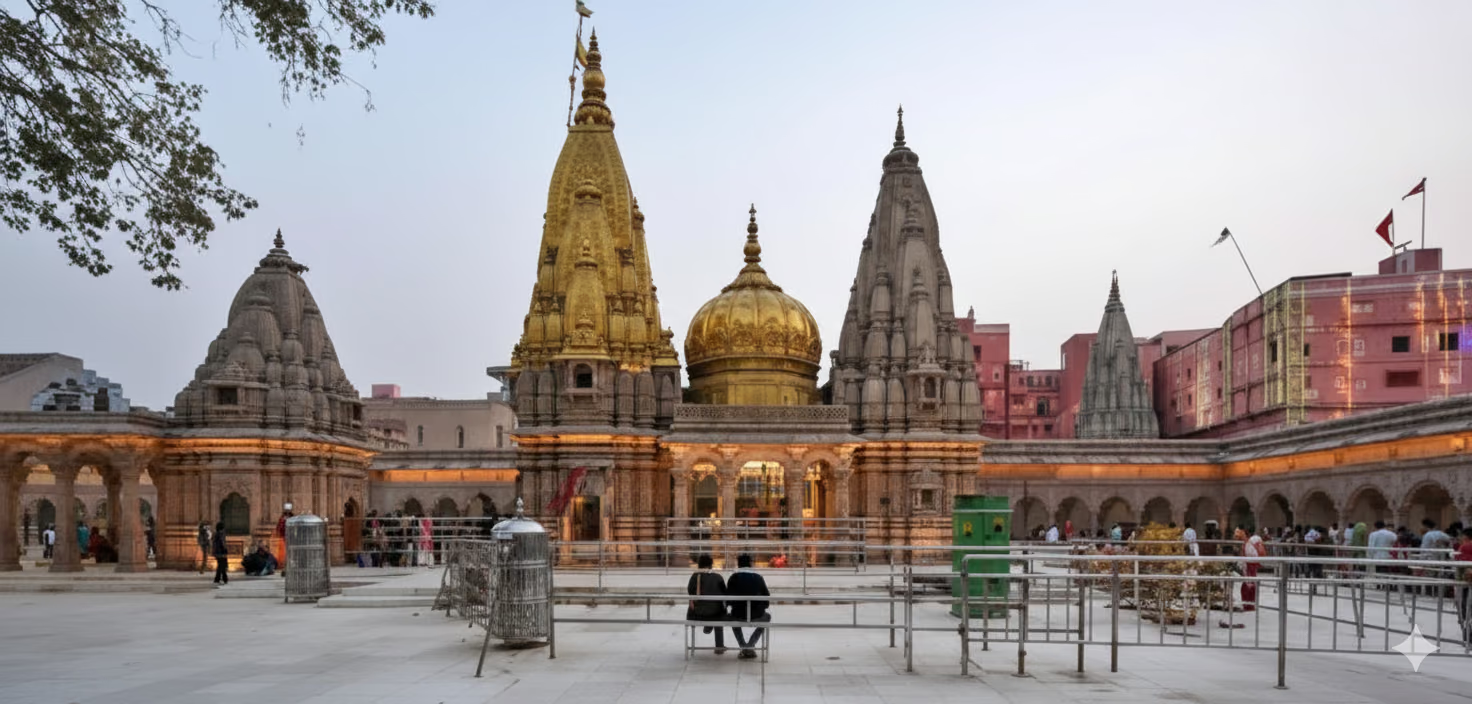
The Kashi Vishwanath Temple is among the holiest of Hindu temples. Enshrining Lord Shiva as one of the twelve Jyotirlingas. The current structure was built in 1780 by the Maratha queen Ahilyabai Holkar. Its distinctive gold-plated spire donated by Maharaja Ranjit Singh of Punjab in 1839. The temple now sits at the heart of the Kashi Vishwanath Corridor. A landscaped pedestrian route connecting it directly to the ghats of the Ganga. Draws millions of pilgrims through the year, especially during Maha Shivratri. The month of Shravan.
Manikarnika Ghat
Manikarnika Ghat is considered the most auspicious cremation site in India — Hindus. Believe that being cremated here breaks the cycle of birth and death. Named after a legendary earring (Manikarnika) said to have fallen into the sacred. Well beside it, the ghat’s funeral pyres are said to have burned continuously. Centuries, tended by a hereditary community of cremation workers. Visitors are welcome to observe respectfully from a distance. It remains one of the most powerful sights along the Varanasi riverfront. Manikarnika Ghat sits at an elevation of 95 m.
New Vishwanath Temple (BHU)
Also known as the Birla Temple, the New Vishwanath Temple stands within the. Leafy campus of Banaras Hindu University. Built entirely of white marble by the Birla family. It was conceived as a temple open to people of every caste. Creed and faith, with its walls inscribed with verses from the Bhagavad Gita. Its tallest of all Shiva temples in India. Its calm campus setting offers a peaceful contrast to the busier temples of the old city. New Vishwanath Temple (BHU) sits at an elevation of 84 m.
Panchganga Ghat
Panchganga Ghat takes its name from the belief. Five rivers — the Ganga, Yamuna, Saraswati, Kirana and Dhutapapa — converge here. Though only the Ganga is visible today. The ghat is dominated by the towering Alamgir Mosque (Beni Madhav ka Darera). Built by the Mughal emperor Aurangzeb on the site of an earlier Vishnu. Temple, making it one of the more striking examples of Varanasi’s layered religious history. Panchganga Ghat sits at an elevation of 89 m. The most favourable months to visit are February, November, December, and January.
Raj Ghat
Raj Ghat sits at the northern edge of Varanasi’s riverfront. Close to the Malviya Bridge (formerly the Dufferin Bridge). Historically the point where the old road from Delhi first met the Ganga. Quieter than the central ghats, it offers a good vantage point of the. Bridge and the sweep of the river, and marks a natural starting. End point for a boat ride along the full stretch of ghats. Raj Ghat sits at an elevation of 85 m. Is typically explored in about 30-60 minutes.
Sankat Mochan Hanuman Temple
Sankat Mochan Hanuman Temple, founded by Goswami Tulsidas. Is one of Varanasi’s most visited temples, particularly thronged on Tuesdays. Saturdays — days considered auspicious for worshipping Hanuman. The temple complex is also home to resident monkeys. Hosts the annual Sankat Mochan Sangeet Samaroh, a five-night classical music. Dance festival that draws performers from across India. Sankat Mochan Hanuman Temple sits at an elevation of 80 m. The most favourable months to visit are February, November, December, and January.
Sankat Mochan Temple
Founded by the poet-saint Tulsidas, Sankat Mochan Hanuman Temple is one of Varanasi’s. Most visited shrines, especially crowded on Tuesdays and Saturdays. Known for the free community meals served in its dining hall. The best time to visit is October to March. Nearby points of interest include Main Hanuman Shrine and Community Dining Hall. Other notable highlights include significant Pilgrimage destination in Varanasi. Rich historical and cultural heritage, and important spiritual or architectural significance. It falls within Uttar Pradesh, India.
Sarnath
Sarnath is one of the four most sacred Buddhist pilgrimage sites in the. World, marking the spot where Buddha first taught the Dharma after attaining enlightenment. The Dhamek Stupa, the ruins of the Ashoka Pillar. Its famous four-lion capital (India’s national emblem). The Sarnath Archaeological Museum draw pilgrims and history lovers alike. It sits a short drive from Varanasi. Is often visited as a half-day trip alongside the ghats. Temples of Kashi.
Scindia Ghat
Built in the 19th century by the Scindia rulers of Gwalior. This ghat is instantly recognisable for the Shiva temple standing at its edge. — its own weight caused it to slowly tilt. Sink partially into the riverbed, now appearing to lean dramatically into the Ganga. The surrounding lanes are packed with old havelis and temples. Making it one of the most photographed stretches of the Varanasi riverfront. Scindia Ghat sits at an elevation of 94 m. Is typically explored in about 30-60 minutes.
Tulsi Ghat
Tulsi Ghat is named after the 16th-century poet-saint Goswami Tulsidas. Author of the Ramcharitmanas — the definitive Hindi retelling of the Ramayana —. Is believed to have lived and composed part of his work at this site. A small akhara (traditional wrestling ground) and a temple in his memory still. Stand nearby, and the ghat remains a quiet. Contemplative stretch of the riverfront popular with scholars and pilgrims. Tulsi Ghat sits at an elevation of 81 m. Is typically explored in about 30-60 minutes.
Popular Routes
Lucknow → Varanasi
The journey from Lucknow, the capital of Uttar Pradesh, to Varanasi, the spiritual heart of India, is a classic pilgrimage route covering approximately 320 kilometers. By road, the trip takes about 6 hours via the Agra-Lucknow Expressway and NH-19, offering a smooth and scenic drive through the Gangetic plains. This route is popular among devotees heading to the ghats of the Ganges, the Kashi Vishwanath Temple, and Sarnath. Travelers can choose between private cars, express trains, or state-run buses, each providing a unique perspective on the region's rural and urban landscapes. The journey is not just a transfer but a prelude to the spiritual immersion that awaits in one of the world's oldest living cities.
Prayagraj → Varanasi
This 125-kilometer pilgrimage route from Prayagraj to Varanasi is a journey through the heart of India's sacred geography, often combined with a visit to the Triveni Sangam—the holy confluence of the Ganga, Yamuna, and the mythical Saraswati. The drive takes about 2.5 hours via the excellent NH-19, passing through the rural landscape of Uttar Pradesh. Along the way, travelers can pause at the ancient city of Kaushambi, known for its Buddhist ruins, or at the modern city of Allahabad (now Prayagraj) before heading east. Varanasi, one of the world's oldest continuously inhabited cities, awaits with its ghats, temples, and the spiritual energy of the Ganga. Whether by car, train, or bus, this route is a seamless blend of devotion, history, and culture, offering a profound experience for pilgrims and travelers alike.
Delhi → Varanasi
The journey from Delhi to Varanasi is a classic Indian pilgrimage route, blending the vibrant capital with the spiritual heart of the country. Covering approximately 820 kilometers, the trip takes around 12 hours by road, with the most common route passing through Kanpur and Lucknow. Travelers can choose between a direct flight (about 1.5 hours), an overnight train (8-12 hours), or a long but scenic road trip. Each mode offers its own unique experience, from the comfort of air travel to the cultural immersion of a train journey. Varanasi, one of the world's oldest living cities, awaits with its ghats, temples, and the sacred Ganges River, making the journey a deeply rewarding prelude to the spiritual exploration ahead.
Gaya → Varanasi
This classic pilgrimage route connects the sacred Buddhist site of Bodh Gaya, where the Buddha attained enlightenment, with the holy Hindu city of Varanasi, the spiritual heart of India. Covering approximately 250 kilometers, the journey by road takes around 5 hours, passing through the plains of Bihar and Uttar Pradesh. Many travelers combine this route with a broader Buddhist circuit that includes Rajgir and Nalanda, making it a seamless continuation of spiritual exploration. The route is well-served by road, rail, and bus, offering flexibility for different travel styles. Along the way, you can experience rural Indian life, historical towns, and the transition from the quiet forests of Bodh Gaya to the bustling ghats of Varanasi. This guide provides detailed options for traveling by car, train, or bus, along with recommended stopovers, practical tips, and answers to common questions.
Getting to Varanasi
Varanasi is reachable by road, rail and air.
Lucknow
Prayagraj
Delhi
Gaya
Nearest Airport
Lal Bahadur Shastri International Airport, Varanasi
Nearest Railway Station
Varanasi Junction (Varanasi Cantt)
Suggested Itineraries
1 Day in Varanasi
1 DayA soul-stirring single day in Varanasi, the eternal city, covering the sacred darshan at Kashi Vishwanath, a contemplative walk along the ancient ghats, and the mesmerizing Ganga Aarti at Dashashwamedh Ghat.
2 Days in Varanasi
2 DaysImmerse yourself in the spiritual heart of Varanasi with a sunrise boat ride on the Ganges, explore the ancient ghats and Kashi Vishwanath Temple, and journey to Sarnath where Buddha first taught. This 2-day itinerary blends sacred rituals, history, and local culture for an unforgettable pilgrimage.
3 Days in Varanasi
3 DaysA relaxed 3-day pilgrimage and cultural journey through Varanasi, covering its ancient ghats, revered temples, the expansive BHU campus, and the timeless craft of Banarasi silk weaving.
Interactive Features
Tour Packages for Varanasi




Explore More of Varanasi
Destination Hub
Varanasi OverviewSpiritual & Temple Guides
Places to Explore
Discover attraction
Discover attraction
Discover attraction
Discover attraction
Discover attraction
Discover attraction
Discover attraction
Discover attraction
Discover attraction
Discover attraction
Discover attraction
Discover attraction
Discover attraction
Discover attraction
Discover attraction
Discover attraction
Discover attraction
Discover attraction
Discover attraction
Discover attraction
Discover attraction
Discover attraction